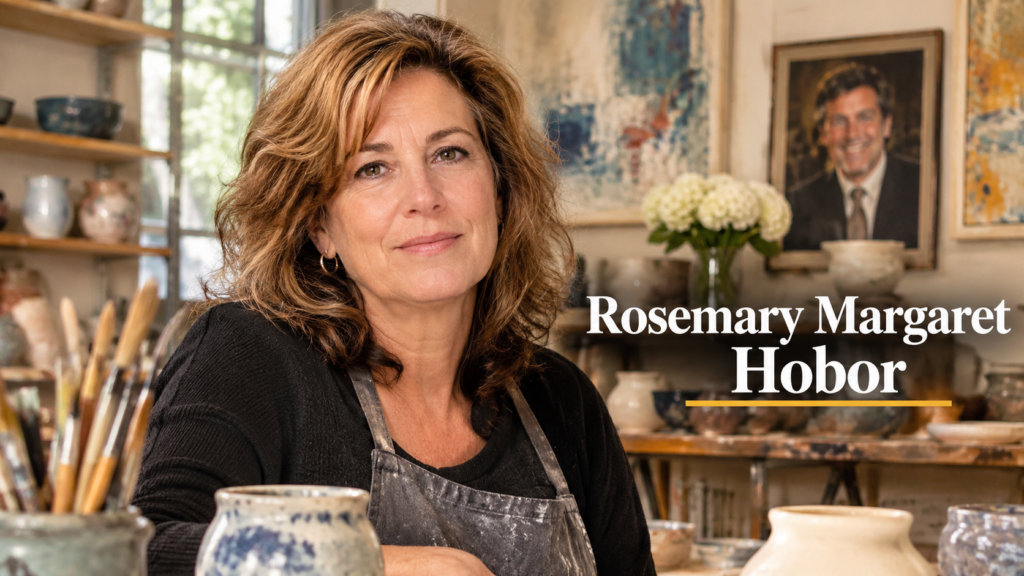
Rosemary Margaret Hobor is often recognised because of her marriage to Canadian comedy legend John Candy. However, her own life tells a story that goes beyond being the wife of a famous actor. She is an accomplished artist who developed a passion for ceramics, painting, sculpture, and creative education long before becoming connected to Hollywood.
While John Candy entertained millions through memorable film and television performances, Rosemary followed a different professional path. She preferred working behind the scenes, developing her artistic skills, and maintaining a private family life. Their marriage lasted until John’s unexpected death in 1994, but the memories they created together continued to shape their family’s story.
Over the years, Rosemary has maintained her connection to the creative world while raising their two children, Jennifer and Christopher. Her involvement in the documentary John Candy: I Like Me also brought renewed attention to her life and the family memories she helped preserve.
Rosemary Margaret Hobor’s Early Interest in Creativity
Rosemary Margaret Hobor developed an interest in the visual arts that eventually became the foundation of her professional life. Although detailed information about her childhood and early family background remains limited, her education provides an insight into the direction she chose.
She studied at the Ontario College of Art and Design in Toronto, Canada. Her education began in 1970, and she completed her graduate year in 1973.
During her studies, she explored several artistic disciplines, including ceramics, sculpture, drawing, photography, woodworking, metalwork, weaving, and three-dimensional design.
This broad education allowed her to experiment with different materials instead of concentrating on a single form of art. She developed an understanding of how ordinary materials could be transformed into creative objects.
Her interest in ceramics became particularly important in her later career. Working with clay gave her the opportunity to combine practical design with artistic expression.
How She Established Herself as an Artist
After completing her studies, Rosemary began developing her professional identity through exhibitions, commissions, and creative projects.
During the 1970s, she participated in several exhibitions in Toronto. Her work appeared at Toronto City Hall, the Yorkville Craft Guild Gallery, and other artistic venues.
She also received commissions for ceramic products. In 1973, she created twelve planters for a greenhouse project in Chicago. The following year, she produced large ceramic planters for the opening of Toronto’s Second City Firehall Theatre.
Another project involved creating ceramic serving containers for a Toronto restaurant.
These assignments demonstrated her ability to produce artwork that was both attractive and practical. Her creations were not limited to gallery displays but could also become part of restaurants, theatres, and everyday environments.
Rosemary received an honourable mention in 1974 and benefited from Ontario Arts Council visiting artist grants during the following years.
Between 1974 and 1979, she also worked with the North York School Board as a visiting artist. This experience introduced another important part of her professional life: teaching and sharing artistic knowledge with others.
Her Marriage to John Candy
One of the most important chapters in Rosemary’s personal life began when she met John Candy.

Their relationship started with a blind date. At that time, John was developing his career in comedy and entertainment. Although he had not yet reached the international popularity that would later define his career, he was already building a reputation as a talented performer.
Their first meeting eventually developed into a serious relationship, and the couple married in 1979.
John became one of Canada’s most recognised comedy actors, appearing in popular productions such as Stripes, Splash, Planes, Trains and Automobiles, and Uncle Buck.
As his career expanded, Rosemary maintained her own interests and professional activities. She did not attempt to become a celebrity simply because of her husband’s success.
Their relationship was built around family life while John continued working in the entertainment industry. The couple generally kept their private experiences away from public attention.
In later interviews, Rosemary shared memories of their early relationship, including how John initially misunderstood her reaction when they first met. These personal stories offered audiences a glimpse of their relationship beyond the familiar image of the comedian.
Raising Their Two Children, Jennifer and Christopher
Rosemary and John Candy became parents to two children, Jennifer and Christopher.

Their daughter, Jennifer Candy, was born in 1980, while their son, Christopher Candy, was born in 1984.
The children grew up in a family connected to the entertainment industry, but their parents generally protected them from unnecessary public attention.
As they became adults, both developed interests in creative work. Jennifer pursued acting and producing, while Christopher explored acting and music.
Their professional interests created a connection with their father’s world, although each developed an individual direction.
For Rosemary, raising her children was an important part of her life. She supported their development while continuing her own artistic activities.
However, the family’s circumstances changed dramatically in 1994 when John Candy died unexpectedly from a heart attack at the age of 43.
His death left Rosemary to continue raising their children without their father. It also marked the beginning of a difficult new period for the family.
Continuing Her Artistic Career in Los Angeles
After moving from Toronto to Los Angeles in 1979, Rosemary continued working toward her creative goals.
She established a personal studio and gradually expanded her activities into teaching and private commissions.
Between 1981 and 1994, she developed children’s clay workshops, giving young students opportunities to explore their artistic abilities.
Her workshops introduced children to basic ceramic techniques, including handbuilding with clay. She also participated in school-based painting and ceramics programmes.
Her involvement in education showed that she valued the process of helping others develop creative skills.
Rosemary later maintained professional connections with The Clay House in Santa Monica and the Brentwood Art Centre. Her association with the latter continued for many years, with her professional biography recording involvement between 1998 and 2018.
Her work included pottery, painting, handmade objects, and commissions for private clients.
Rose Candy Studio and Her Independent Creative Identity

An important development in Rosemary’s artistic journey came in 2014 when she established Rose Candy Studio and Gallery in Santa Monica, California.
The studio gave her a dedicated space to present her creative work and connect with people interested in handmade ceramics and original paintings.
Her artistic interests included ceramic bowls, decorative vases, paintings, drawings, and photography.
She also accepted individual commissions, allowing clients to request pieces created for particular purposes.
Some of her documented projects included ceramic vases for Lululemon locations and handmade coffee cups for private clients.
Over time, she experimented with different materials and techniques, including porcelain and various painting methods.
In 2024, Rosemary announced that her Santa Monica gallery had closed. However, closing the physical location did not mean she was leaving the art world.
She continued sharing updates about her projects and remained involved in creating new artwork.
Her professional identity as Rose Candy allowed her to maintain a connection with collectors and people interested in her creative work.
Her Involvement in the John Candy Documentary

More than three decades after John Candy’s death, Rosemary became involved in a project that introduced his story to another generation.
The documentary John Candy: I Like Me, directed by Colin Hanks, explored the comedian’s professional achievements and personal life.
Rosemary and their children, Jennifer and Christopher, served as co-executive producers.
Their involvement helped bring personal memories, family photographs, and archival material into the documentary.
The project became especially meaningful because the family had previously been cautious about allowing new productions based on John’s life.
A tribute organised by Ryan Reynolds in 2019 helped encourage the family to reconsider how John’s story could be shared.
The documentary premiered at the Toronto International Film Festival in September 2025 and was subsequently released on Prime Video.
For Rosemary, participating in the project provided an opportunity to share memories of the man she had known as a husband and father, rather than simply the famous comedian audiences remembered.
It also allowed Jennifer and Christopher to contribute their own perspectives on growing up with John.
Where Is Rosemary Margaret Hobor Today?
Rosemary Margaret Hobor continues to be associated with the visual arts and her professional identity as Rose Candy.
Her work has included ceramics, painting, photography, private commissions, and educational activities. Although she has generally avoided the celebrity spotlight, her artistic career has developed over several decades.
She also remains connected to John Candy’s legacy through her children and projects celebrating his life.
Her story is interesting because she maintained an identity beyond her husband’s fame. She pursued formal art education, developed a professional career, worked with students, established her own studio, and continued creating artwork through different stages of her life.
Today, Rosemary is remembered both as the wife of a much-loved comedian and as an independent artist whose creative interests have remained an important part of her personal story.