
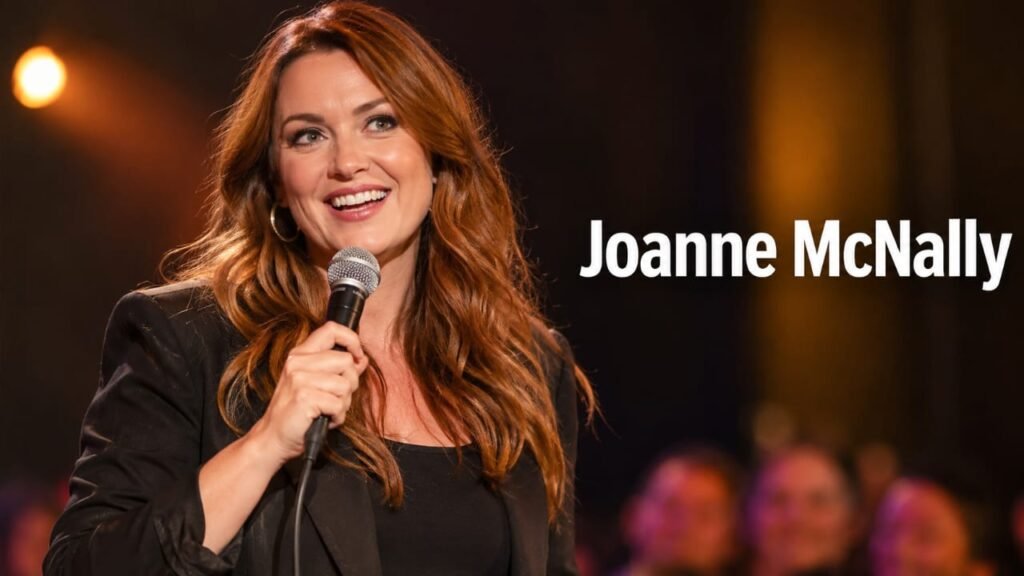
Joanne McNally did not become a successful comedian by following a carefully planned route to fame. Before selling tickets to major live shows and building a devoted podcast audience, she worked in public relations, struggled to find a career that suited her, and faced a personal crisis that forced her to reconsider her future. Her eventual success came from turning the experiences she once found difficult to discuss into material that audiences could recognise, laugh about, and sometimes learn from.
Today, Joanne McNally is an Irish stand-up comedian, writer, actress, and podcaster known for her outspoken humour and willingness to discuss subjects that many people prefer to keep private. Her partnership with television presenter Vogue Williams on My Therapist Ghosted Me has expanded her audience beyond comedy clubs, while her solo shows have established her as a major live performer in Ireland and the United Kingdom.
Her story is not simply about becoming famous later in life. It is about finding a professional voice after years of uncertainty and discovering that the parts of her experience she once struggled with could become the foundation of her comedy.
Growing Up in Ireland and Finding Her Voice
Joanne McNally was born on 7 May 1983 in County Roscommon, Ireland, and grew up in Killiney, County Dublin. She was adopted as a child by Nora and Frank McNally, and her upbringing and experience of adoption have become part of the wider conversation surrounding her life.
McNally attended a private girls’ school and later considered a career in journalism. Although she had an interest in writing and communicating, she did not initially feel confident enough to pursue the path she had imagined. Instead, she moved into public relations, beginning a professional life that looked quite different from the one she would eventually build on stage.
Her early career also included time in Australia, where she experienced the less glamorous side of living abroad, including shared accommodation and ordinary jobs. The experience gave her material and perspective, but it did not immediately lead her towards comedy.
At that point, performing in front of an audience was not an obvious career choice. McNally would spend years working outside entertainment before discovering that her instinct for storytelling could become something more than an informal part of her personality.
The Personal Struggles Behind Her Later Success
While working in public relations, McNally struggled with bulimia, an eating disorder that affected her life over a number of years. In interviews, she has spoken openly about the condition, the insecurity she experienced when she was younger, and the way her difficulties became increasingly serious.
Changing jobs did not immediately solve the problem. She moved from public relations into work with a mental health charity, hoping that a less demanding professional environment might help. Instead, her condition worsened, and she eventually reached a point when continuing with her existing routine was no longer possible.
In her early thirties, McNally left her job and moved into her mother’s attic while trying to recover and work out what to do next. She has described this period as a major personal crisis, one that forced her to confront the fact that her life could not continue as it had.
Her experiences with bulimia and treatment are important parts of her story, but they do not define the entirety of her identity. McNally has continued to discuss the lasting effects of the disorder while building a career that reaches far beyond those experiences.
Her willingness to address difficult subjects also helped shape the style that would later distinguish her comedy. Rather than presenting herself as someone who had always known what she wanted, she spoke about the uncomfortable realities of being uncertain, making mistakes, and trying to move forward.
How a Theatre Production Changed Her Career
McNally’s move into comedy began through an unexpected opportunity rather than a traditional stand-up route.
In 2014, writer and director Una McKevitt invited her to appear in Singlehood, a stage production exploring relationships and single life through a mixture of performers and personal stories. McNally contributed an account of her dating experiences, discovering an audience for the kind of frank, observational storytelling that would later become central to her work.
The production proved significant because it allowed her to perform without first having to establish herself as a conventional stand-up comedian. Her stories had humour, sharp observations, and a directness that suited the stage.
Comedian PJ Gallagher subsequently encouraged her to pursue stand-up and take the next step professionally. Although McNally initially found the suggestion surprising, she began performing and gradually developed her own material.
Her first one-woman show, Bite Me, addressed eating disorders and her personal experiences with bulimia. The production received multiple nominations at the 2016 Dublin Fringe Festival, including recognition for performance and production.
The show demonstrated that McNally could approach a difficult subject without reducing it to a simple story of recovery. She combined personal disclosure with humour, allowing audiences to engage with an uncomfortable topic while still recognising its seriousness.
It also established an important pattern in her career: she was willing to discuss subjects that were not always considered easy material for comedy, particularly when they involved women’s experiences and social expectations.
From Edinburgh Fringe Shows to Bigger Stages
Following the early success of Bite Me, McNally continued developing her stand-up career through live performances and new shows. Two important productions were Wine Tamer and The Prosecco Express, which helped strengthen her reputation in Ireland and at the Edinburgh Festival Fringe.
These shows drew on her experiences of relationships, dating, social life, and the pressures surrounding adulthood. Her style relied on direct storytelling, sharp observations, and a willingness to expose her own imperfections rather than present an idealised version of herself.
Building a comedy career required persistence. McNally had started later than some performers, and success was not immediate. She worked to establish herself through live gigs and professional opportunities, eventually expanding her presence in London and the wider UK comedy scene.
Her television work added another dimension to her career. She co-hosted RTÉ’s Republic of Telly and appeared on programmes including The Late Late Show, The Tommy Tiernan Show, and BBC Northern Ireland’s The Blame Game. She also developed experience as a writer and presenter.
Her documentary Baby Hater, which she created, wrote, and presented, explored attitudes towards motherhood and the decision not to have children. The programme was sold internationally, extending her work beyond stand-up.
Rather than limiting herself to one format, McNally built a career across live comedy, television, writing, and broadcasting. Each offered a different way to connect with audiences while maintaining the candid approach that had helped her stand out.
The Podcast That Expanded Her Audience
McNally’s career took another major turn during the COVID-19 pandemic, when restrictions brought live comedy to a halt. Like many performers, she had to find ways to reach audiences without relying on theatres and comedy clubs.
She began exploring podcasting and worked with Irish broadcaster Muireann O’Connell on Let’s Solve Nothing. She later teamed up with Vogue Williams, a television and media personality, to create My Therapist Ghosted Me.
The podcast’s title came from McNally’s account of a therapist who stopped responding to her. The premise suited the hosts’ conversational style, which mixes personal stories, relationship discussions, celebrity news, and observations about everyday life.
Williams and McNally have different personalities, and their contrasting approaches help give the programme its rhythm. Rather than sounding like a formal interview show, their conversations often resemble an unfiltered exchange between friends.
The podcast developed a substantial audience and helped turn McNally into a recognisable voice for listeners who might not regularly attend stand-up shows. It also created new opportunities for live performances built around the hosts’ shared popularity.
For McNally, podcasting became more than a temporary replacement for live work. It offered a direct connection with listeners and introduced her humour to people who could later become ticket-buying audiences for her solo shows.
Personal Life, Adoption, and Speaking Honestly
Although McNally shares many personal stories in her comedy and podcast, she has not made every part of her private life public. Her public image is built partly on candour, but that does not mean every rumour or claim about her relationships should be treated as fact.
Her adoption is one aspect of her background that has attracted interest, and she has discussed identity and her life experiences in interviews. She has also spoken openly about dating, remaining single, and the expectations placed on women as they grow older.
These subjects regularly appear in her comedy because they connect private experiences with wider social questions. Her material can be provocative, but its appeal comes from the recognisable situations beneath the jokes: awkward dates, changing friendships, insecurity, and the pressure to follow a conventional timetable for adulthood.
McNally has also continued to speak about her eating disorder. Her openness offers a more complicated picture than the carefree, outspoken performer audiences encounter on stage. It shows how humour can coexist with difficult experiences without pretending that those experiences disappear completely.
Joanne McNally’s Career Today
By 2026, McNally had developed from a performer finding her feet into an established comedian with an international audience. Her work on My Therapist Ghosted Me continued alongside her live career, while her Pinotphile tour brought her solo comedy to major venues in Ireland and the UK.
Her professional success reflects the combination of several skills: storytelling, writing, performance, and an ability to make personal observations feel relevant to a large audience. The podcast widened her reach, but live comedy remains a central part of her work.
McNally’s path also challenges the idea that a successful career must begin early or follow a straight line. She spent years working in a different profession before discovering stand-up, and her breakthrough came after a period of considerable personal difficulty.
What connects her early theatre work, her stand-up shows, and her podcast is a recognisable voice: direct, funny, self-aware, and prepared to address subjects that are often avoided in polite conversation.
Her career continues to develop, but its defining feature remains the way she turns ordinary experiences and uncomfortable truths into stories people want to hear. For Joanne McNally, the route to comedy success was neither simple nor predictable. It began when she found a stage on which her own voice finally made sense.



Pingback: King Kenny: From YouTube Pranks to Boxing and Television